What Your Body Knows Before Your Brain Does: The Science of Stress Signatures
You’re sitting in a meeting. Everything seems fine. But your jaw is clenched. Your shoulders are up near your ears. Your breath is shallow. And you didn’t notice any of it until someone asked if you were okay.
Or you’re at home, and your partner says something that shouldn’t be a big deal. But suddenly your chest is tight, your hands are shaking, and you’re flooded with a feeling you can’t name. You tell yourself you’re overreacting. But your body is screaming that something is wrong.
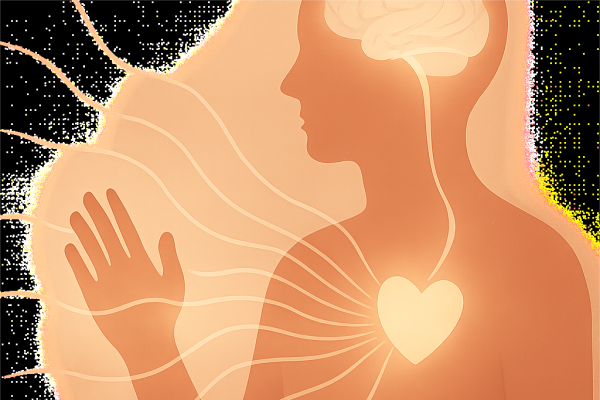
Here’s what’s happening: your body is responding to threat before your conscious mind has processed it. Your nervous system has detected danger—real or perceived—and it’s already mobilizing a stress response. By the time you’re aware of feeling “off,” your body has been broadcasting the alarm for minutes, maybe hours.
This is your stress signature—the specific, predictable pattern your body goes into when your nervous system is activated. And learning to recognize it early is one of the most powerful regulation tools you have.
Because if you can catch activation before it takes over, you can intervene. But if you wait until you’re flooded, it’s too late.
WHAT A STRESS SIGNATURE IS
Your stress signature is the unique combination of physical, emotional, and behavioral cues that show up when your nervous system is activated. It’s your body’s early warning system—and it’s entirely individual.
For some people, stress shows up as:
Tension in the jaw, neck, or shoulders
Shallow breathing or holding the breath
Stomach tightness or nausea
Restlessness or needing to move
Brain fog or difficulty concentrating
Irritability or snapping at people
Shutting down emotionally or going quiet
For others, it might be:
Racing thoughts or catastrophizing
Skin picking, nail biting, or other repetitive behaviors
Sudden fatigue or wanting to sleep
Craving sugar, caffeine, or other quick hits
Withdrawing from connection
The specific pattern doesn’t matter. What matters is that your body has a pattern—and it will reliably show up the same way every time your system is under threat.
The problem is that most people don’t notice their stress signature until they’re already deep into activation. And by then, the prefrontal cortex (the part of your brain responsible for rational thinking, planning, and regulation) is offline. You’re running on survival brain, and no amount of logic will bring you back.
WHY YOUR BODY KNOWS FIRST
Your nervous system is constantly scanning for safety or threat. This process, called neuroception (a term coined by Stephen Porges in polyvagal theory), happens below conscious awareness. Your body is reading cues from your environment, your relationships, and your internal state—and it’s deciding whether you’re safe, in danger, or in life-threatening crisis.
And it’s fast. Much faster than your thinking brain.
Here’s the sequence:
Your nervous system detects a cue (a tone of voice, a facial expression, a memory, a bodily sensation).
Your body responds (heart rate changes, muscles tense, breathing shifts).
Your emotions follow (anxiety, anger, shutdown).
Your conscious mind catches up (you realize you’re feeling “off” or upset).
By the time you’re consciously aware that something is wrong, your body has already been in a stress response for seconds or minutes. And if you don’t know how to read your body’s signals, you’ll miss the window where regulation is still possible.
This is why people say things like, “I don’t know why I’m so anxious right now—nothing even happened.” Something did happen. Your nervous system detected it. Your body responded. You just weren’t paying attention to the early cues.
THE COST OF IGNORING YOUR STRESS SIGNATURE
When you don’t recognize your stress signature early, you miss the chance to intervene before you’re flooded. And once you’re flooded, everything gets harder.
Here’s what happens:
You lose access to your best thinking.
When your nervous system is activated, blood flow shifts away from your prefrontal cortex and toward your survival brain. You can’t think clearly, solve problems creatively, or regulate your emotions effectively. You’re in react mode, not respond mode.
You leak stress onto the people around you.
Your stress becomes contagious. Your partner feels it. Your kids feel it. Your team feels it. Even if you’re not saying anything, your body is broadcasting activation—and other nervous systems pick up on it.
You make decisions you’ll regret.
You snap at your kid. You send the email you shouldn’t send. You shut down the conversation you needed to have. Because when you’re activated, you’re operating from survival brain—and survival brain prioritizes safety over connection, defense over curiosity, and reactivity over thoughtfulness.
You stay activated longer.
The earlier you catch activation, the easier it is to regulate. But if you ignore your stress signature until you’re fully flooded, it takes much longer to come back down. What could have been a 5-minute reset becomes a 2-hour recovery.
HOW TO IDENTIFY YOUR STRESS SIGNATURE
Most people have never been taught to pay attention to their body’s signals. So here’s how to start:
Step 1: Track your early warning signs.
For the next week, notice what happens in your body when you start to feel stressed, anxious, irritated, or overwhelmed. Don’t wait until you’re flooded—pay attention to the subtle cues that show up first.
Ask yourself:
Where do I feel tension first? (Jaw? Shoulders? Stomach?)
How does my breathing change? (Shallow? Held? Fast?)
What do I do with my body? (Fidget? Go still? Clench my hands?)
What’s my first impulse? (Withdraw? Snap? Distract myself?)
Write it down. You’re looking for patterns.
Step 2: Notice the context.
What situations reliably activate your stress signature? Some common triggers:
Conflict or perceived criticism
Transitions or time pressure
Feeling unseen, unheard, or misunderstood
Loss of control or uncertainty
Sensory overload (noise, crowds, chaos)
You’re not trying to avoid these triggers—you’re just building awareness so you can recognize when your system is likely to go into activation.
Step 3: Name it when it happens.
The next time you notice your stress signature showing up, pause and name it: “My system is activated right now.”
This simple act of naming shifts you out of survival brain and back into awareness. It creates a tiny gap between stimulus and response—and that gap is where regulation lives.
WHAT TO DO ONCE YOU RECOGNIZE YOUR SIGNATURE
Recognizing your stress signature is the first step. The second step is learning how to intervene early, before you’re flooded.
Here are three tools that work:
1. The 30-Second Reset
When you notice your stress signature, pause. Put your hand on your chest or your belly. Take three slow breaths, making your exhale twice as long as your inhale. (Inhale for 3, exhale for 6.)
This activates your parasympathetic nervous system and signals safety to your body. You’re not trying to “calm down” entirely—you’re just downshifting enough to stay online.
2. Movement
Stress is energy that needs to move through your body. When you notice activation, move. Stand up. Stretch. Shake out your hands. Walk around the block. Jump up and down.
This isn’t “working out”—it’s completing the stress cycle so the energy doesn’t get trapped in your system.
3. Name What You’re Feeling Out Loud
Say it to yourself or to someone you trust: “I’m feeling activated right now.” or “My system just went into protection mode.”
Naming what’s happening externalizes it. It shifts you from being inside the experience to observing it. And observation creates choice.
WHY THIS MATTERS FOR PARENTS AND LEADERS
If you’re parenting or leading, your stress signature doesn’t just affect you—it affects everyone around you.
For parents:
Your kid is melting down. If you’re already activated (jaw tight, breath shallow, irritation rising) and you don’t notice it, you’re going to react instead of respond. But if you catch your stress signature early and take 30 seconds to regulate, you can stay present and help them settle instead of escalating the situation.
For leaders:
You’re walking into a tense meeting. If you’re already in activation (shoulders up, chest tight, brain racing) and you don’t notice it, you’re going to bring that energy into the room—and your team will feel it. But if you catch it beforehand and take a few breaths, you can walk in regulated and set the tone for everyone else.
Your stress signature is the first domino. If you can catch it early, you can prevent the cascade. If you can’t, everyone downstream pays the price.
ONE PRACTICE TO TRY THIS WEEK
Here’s how to start building awareness of your stress signature:
The Body Scan Check-In
Three times a day—morning, midday, and evening—pause for 30 seconds and scan your body.
Ask:
Where am I holding tension right now?
How’s my breathing?
What’s my jaw doing? My shoulders?
If my body could speak, what would it say it needs?
You’re not trying to fix anything. You’re just building the habit of checking in with your body before it has to shout to get your attention.
Over time, this practice makes your stress signature easier to recognize. And the earlier you recognize it, the more control you have over how you respond.
WHY THIS MATTERS
Your body is always communicating. It’s telling you when you’re safe, when you’re threatened, when you’re maxed out, and when you need to pause. The question is whether you’re listening.
Most people wait until their body is screaming—through illness, injury, collapse, or breakdown—before they pay attention. But by then, regulation is much harder.
Learning to recognize your stress signature early is one of the most powerful tools you have. It’s not about never being stressed. It’s about catching activation before it takes over—so you can choose your response instead of defaulting to your pattern.
Your body knows before your brain does. Start listening.
CITATIONS
Porges, S. W. (2021). Polyvagal Theory: A Science of Safety. Frontiers in Integrative Neuroscience. https://www.frontiersin.org/articles/10.3389/fnint.2021.727545
van der Kolk, B. (2014). The Body Keeps the Score: Brain, Mind, and Body in the Healing of Trauma. Viking.
Dana, D. (2018). The Polyvagal Theory in Therapy: Engaging the Rhythm of Regulation. W.W. Norton & Company.
Hanson, R., & Mendius, R. (2009). Buddha’s Brain: The Practical Neuroscience of Happiness, Love, and Wisdom. New Harbinger Publications.
