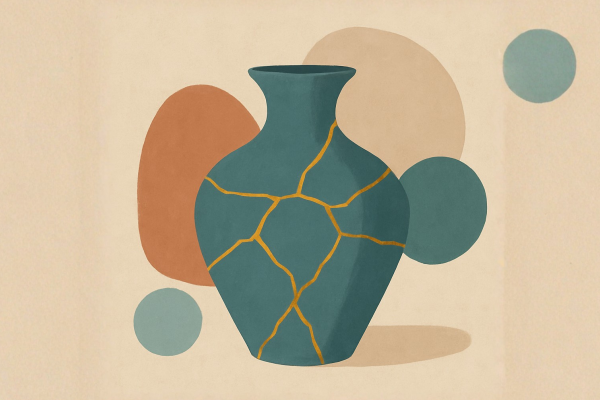
Resilience Isn't What You Think: Why Recovery > Endurance
You’ve been told that resilience means bouncing back. That it’s about grit, perseverance, and the ability to keep going no matter what. That resilient people don’t break under pressure—they endure.
And so you’ve trained yourself to push through exhaustion, override your body’s signals, and treat rest as something you’ll get to later. You wear your capacity to keep going as a badge of honor. You’re resilient.
Except you’re also irritable, exhausted, and one bad day away from collapse. And you can’t figure out why you feel so fragile when you’re supposed to be so strong.
Here’s the truth: resilience isn’t about enduring more stress. It’s about recovering from it. The resilience you’ve been chasing—the kind that never breaks, never needs rest, never falters—isn’t resilience at all. It’s denial. And it’s breaking you.
Real resilience isn’t measured by how much you can take. It’s measured by how well you recover, how quickly you repair, and whether you have the capacity to come back after things fall apart.
If you want to be resilient, stop trying to be unbreakable. Start learning how to put yourself back together.
THE MYTH: RESILIENCE = ENDURANCE
Somewhere along the way, we started equating resilience with the ability to withstand endless pressure without showing cracks. The person who never complains. The parent who handles everything. The leader who stays calm no matter what.
This version of resilience is attractive because it looks strong. It looks like control. And in a culture that glorifies productivity and pathologizes rest, endurance gets rewarded.
But here’s the problem: endurance without recovery isn’t resilience. It’s pre-collapse.
You can white-knuckle your way through stress for a while. Your body is incredibly adaptive. But chronic activation without downshifts doesn’t build capacity—it erodes it. You’re not getting stronger. You’re getting brittle.
True resilience isn’t about never breaking. It’s about being able to break—and then repair, recover, and come back.
WHAT RESILIENCE ACTUALLY IS
Resilience, as defined by research in developmental psychology and trauma recovery, is the capacity to adapt in the face of adversity, recover from setbacks, and grow through challenge.
Notice what’s in that definition:
Adapt (not endure)
Recover (not push through)
Grow (not just survive)
Resilience isn’t static. It’s not something you either have or don’t have. It’s a dynamic process that requires oscillation between stress and recovery, activation and rest, effort and repair.
Think of resilience like physical strength. You don’t build muscle by lifting weights 24/7 without rest. You build muscle by stressing the tissue, then allowing it to recover. The growth happens during recovery, not during the workout.
Your nervous system works the same way. Stress isn’t the problem. Stress without recovery is.
Resilience isn’t built by never breaking. It’s built by learning how to come back after you do.
WHY THE ENDURANCE MODEL FAILS
When you treat resilience as endurance, here’s what happens:
You stop listening to your body’s signals.
Your body tells you it’s tired. You override it. Your body tells you it needs rest. You ignore it. Your body tells you something is wrong. You push through.
Over time, you lose the ability to recognize when you’re maxed out—until your body forces the issue through illness, injury, or breakdown.
You mistake numbness for strength.
You stop feeling stress because you’ve learned to disconnect from your body. You think this means you’re handling it. But what you’ve actually done is go into freeze—a dorsal vagal shutdown where your system has collapsed to protect itself.
You’re not resilient. You’re dissociated.
You burn through your reserves.
Every time you push through without recovering, you’re drawing from a finite well. Eventually, the well runs dry. And when it does, even small stressors feel catastrophic because you have no capacity left.
You model unsustainable patterns for the people around you.
If you’re a parent, your kids learn that rest is weakness and that pushing through is strength. If you’re a leader, your team learns that burnout is expected and that self-care is optional.
You’re not building resilience in others. You’re teaching them how to break themselves.
WHAT REAL RESILIENCE LOOKS LIKE
Real resilience isn’t about never falling apart. It’s about having the skills and support to put yourself back together when you do.
Here’s what that actually looks like:
You recognize when you’re depleted—and you rest.
Resilient people don’t wait until they’re burned out to pause. They build rest into their rhythm. They recognize the early signs of depletion and respond before they hit empty.
Rest isn’t a reward for finishing the work. It’s the foundation that makes the work sustainable.
You repair after rupture.
Resilience isn’t about never messing up. It’s about coming back after you do. You snap at your kid. You’re harsh with your partner. You miss a deadline. And then you repair.
You don’t shame yourself into oblivion. You don’t pretend it didn’t happen. You acknowledge the rupture, take responsibility, and rebuild the connection.
You oscillate between stress and recovery.
Resilient people don’t live in constant activation. They move between effort and rest, challenge and ease, doing and being. They understand that capacity is built through oscillation—not through relentless grinding.
You ask for help when you need it.
Resilience isn’t rugged individualism. It’s relational. The most resilient people aren’t the ones who do it all alone—they’re the ones who know how to reach out, lean on others, and let themselves be supported.
Isolation masquerading as independence isn’t strength. It’s a setup for collapse.
You prioritize connection over performance.
When things get hard, resilient people don’t withdraw into productivity. They turn toward connection. They reach out. They let people in. They allow themselves to be held.
Because resilience isn’t built in isolation—it’s built in relationship.
THE SCIENCE: WHY RECOVERY IS NON-NEGOTIABLE
Research on stress and recovery makes this clear: your body needs downshifts to function.
When you experience stress, your sympathetic nervous system activates. Heart rate increases. Cortisol and adrenaline flood your system. Blood flow shifts away from digestion and immune function toward muscles and survival brain. This is adaptive—for short bursts.
But chronic activation without recovery leads to:
Suppressed immune function
Increased inflammation
Impaired memory and concentration
Emotional dysregulation
Disrupted sleep
Increased risk of chronic illness
Recovery isn’t optional. It’s how your body repairs damage, processes stress, consolidates learning, and restores capacity.
And recovery doesn’t mean vacation once a year. It means daily, intentional downshifts that allow your parasympathetic nervous system (rest and digest) to come online.
The most resilient people aren’t the ones who never stop. They’re the ones who’ve mastered the art of strategic pausing.
HOW TO BUILD RECOVERY INTO YOUR LIFE
If resilience is built through recovery, here’s how to actually do it:
1. Normalize micro-recoveries throughout your day.
You don’t need an hour. You need 5 minutes, multiple times a day.
Examples:
After a hard conversation, step outside and take five deep breaths
Between meetings, stand up and stretch
After your kid’s meltdown, sit down and put your hand on your chest for 30 seconds
At the end of the workday, close your laptop and take a 5-minute walk before transitioning home
These aren’t indulgences. They’re the pauses that prevent burnout.
2. Protect one non-negotiable rest practice per week.
Not “if I have time.” Not “when things calm down.” Now.
Examples:
One morning where you don’t check your phone for the first hour
One evening where you completely unplug
One walk where you leave your to-do list behind
One hour of doing absolutely nothing
The specifics don’t matter. What matters is that you practice the skill of stopping before you’re forced to.
3. Track your capacity, not just your output.
At the end of each day, ask:
How depleted am I right now (1-10)?
What helped me recover today?
What drained me that I didn’t see coming?
You’re not trying to be perfect. You’re building awareness of what restores you and what costs you—so you can make more intentional choices.
4. Repair after hard days.
When you’ve had a rough day, don’t just power through to the next one. Pause. Acknowledge it. Let yourself feel it. Talk to someone. Move your body. Do something small that signals to your nervous system: We’re taking care of this.
Unprocessed stress accumulates. Repair prevents buildup.
5. Reframe rest as infrastructure.
Stop treating rest as something you “deserve” only after you’ve earned it. Rest is what makes everything else possible. It’s not a luxury—it’s the foundation.
If you wouldn’t expect a phone to run 24/7 without charging, why do you expect that of yourself?
ONE SHIFT TO MAKE THIS WEEK
Here’s a practice that reframes resilience from endurance to recovery:
The Post-Stress Recovery Ritual
After any stressful event this week—a hard conversation, a meltdown, a tense meeting—don’t immediately move to the next thing.
Pause for 5 minutes and do one of the following:
Five slow breaths with longer exhales
A short walk
Stretch or shake out your body
Splash cold water on your face
Call someone you trust and say, “That was hard. I’m good, but I needed to say it out loud.”
You’re not “wasting time.” You’re completing the stress cycle so it doesn’t get trapped in your body. You’re practicing recovery in real time.
Over time, this becomes automatic. And that’s when resilience stops being something you force and starts being something you build.
WHY THIS MATTERS
Resilience isn’t about being unbreakable. It’s about knowing how to come back after you break.
The version of resilience that glorifies endurance and pathologizes rest is killing people. It’s creating cultures where burnout is normalized, where asking for help is seen as weakness, and where rest is something you “get to do” only after you’ve completely depleted yourself.
Real resilience requires oscillation. Stress and recovery. Activation and rest. Effort and repair.
If you want to be resilient, stop trying to be invincible. Start learning how to recover well. Because the people who last aren’t the ones who never fall apart—they’re the ones who know how to put themselves back together.
CITATIONS
Masten, A. S. (2018). Resilience Theory and Research on Children and Families: Past, Present, and Promise. Journal of Family Theory & Review, 10(1), 12-31. https://onlinelibrary.wiley.com/doi/10.1111/jftr.12255
McEwen, B. S. (2020). Stress, Adaptation, and Disease: Allostasis and Allostatic Load. Annals of the New York Academy of Sciences, 840(1), 33-44. https://nyaspubs.onlinelibrary.wiley.com/doi/10.1111/j.1749-6632.1998.tb09546.x
Southwick, S. M., & Charney, D. S. (2018). Resilience: The Science of Mastering Life’s Greatest Challenges (2nd ed.). Cambridge University Press.
Walsh, F. (2016). Strengthening Family Resilience (3rd ed.). Guilford Press.
