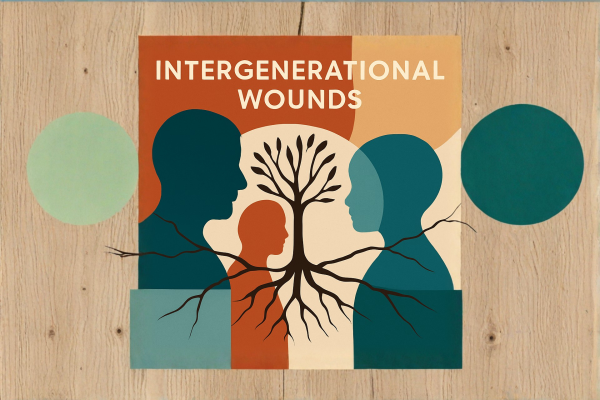
Intergenerational Wounds: Breaking Cycles You Didn't Start
You swore you’d never parent the way you were parented. You’d be different. More present. Less reactive. More emotionally available.
And yet, you hear yourself say the exact thing your parent said to you—the thing that made you feel small. Or you feel yourself shutting down in conflict the same way they did. Or you find yourself repeating the same patterns you promised you’d never pass on.
You’re not doing it on purpose. You hate that you’re doing it. But in the moment—when you’re maxed out, when your kid is pushing every button, when you’re activated and exhausted—the old wiring takes over.
Here’s what’s happening: you’re carrying wounds you didn’t create. Patterns you inherited. Nervous system responses that were shaped long before you became a parent. And until you understand where they came from and how they’re showing up, you’ll keep passing them on—even though you’re trying desperately not to.
This is the work of breaking intergenerational cycles. It’s not about blaming your parents or your childhood. It’s about recognizing what you inherited, grieving what you didn’t get, and consciously choosing to do it differently—so the cycle stops with you.
WHAT INTERGENERATIONAL WOUNDS ARE
Intergenerational wounds are the unhealed patterns, beliefs, and nervous system responses that get passed down from one generation to the next. They’re not genetic—they’re relational and environmental. They’re transmitted through attachment, modeling, and the emotional climate of your family.
Here’s how it works:
Your parents (or caregivers) had their own attachment wounds, unmet needs, and survival strategies. Maybe they grew up in poverty and learned that emotions were a liability. Maybe they experienced trauma and learned to dissociate. Maybe they were raised by critical parents and learned that love is conditional.
They didn’t consciously choose to pass those patterns on. But patterns that aren’t healed get repeated. And so the way they parented you was shaped by what they experienced—and by what they never learned how to heal.
Now you’re a parent. And when you’re stressed, when you’re triggered, when you’re operating from survival brain instead of thinking brain, you default to the patterns you learned. Not because you want to. But because those patterns are wired into your nervous system.
Common intergenerational patterns include:
Emotional unavailability: If your parents didn’t attune to your emotions, you may struggle to attune to your child’s emotions—or you may overcompensate by being overly enmeshed.
Harsh discipline or control: If you were parented through fear, shame, or dominance, you may find yourself defaulting to those same tactics when you’re overwhelmed.
Avoidance of conflict: If conflict in your family was explosive or dangerous, you may shut down or withdraw instead of engaging—even when engagement is needed.
Perfectionism and conditional love: If you had to earn love through achievement, you may unconsciously communicate to your child that they’re only worthy when they perform.
Enmeshment or poor boundaries: If your parent relied on you for emotional support or didn’t allow you autonomy, you may struggle to let your child have their own emotional experience without making it about you.
These aren’t character flaws. They’re adaptive survival strategies that made sense in the environment where you learned them. The problem is that what helped you survive as a child doesn’t always help you thrive as a parent.
HOW WOUNDS GET PASSED DOWN
Intergenerational transmission happens in three main ways:
Through modeling
You learned how to be in relationships by watching your parents. How they handled conflict. How they expressed (or didn’t express) emotions. How they treated you when you made mistakes.
Even if you consciously rejected those patterns, they’re still encoded in your nervous system as the template for “how relationships work.” And when you’re stressed, you default to what’s familiar—not what’s healthy.Through attachment patterns
Your attachment style (secure, anxious, avoidant, or disorganized) was shaped by your early relationships with your caregivers. And unless you’ve done intentional work to shift it, that’s the attachment pattern you’re likely replicating with your own kids.
If your parent was inconsistent, you may have developed anxious attachment—and now you might be overly attuned to your child’s emotions in a way that creates enmeshment. If your parent was emotionally unavailable, you may have developed avoidant attachment—and now you might struggle to stay present when your child needs you.Through unprocessed trauma
Trauma that isn’t processed doesn’t just disappear. It lives in your body, shapes your nervous system, and influences how you respond to stress.
If your parent experienced trauma and never healed it, they passed on a dysregulated nervous system, hyper-vigilance, or a collapsed sense of safety. And if you experienced trauma and haven’t processed it, you’re at risk of doing the same.
This doesn’t mean you’re doomed to repeat the cycle. It just means that breaking the cycle requires intentional, conscious work.
THE GRIEF OF RECOGNIZING WHAT YOU DIDN’T GET
One of the hardest parts of breaking intergenerational cycles is recognizing—and grieving—what you didn’t receive.
Maybe you didn’t get emotional attunement. Maybe you didn’t get safety. Maybe you didn’t get the sense that your feelings mattered, that you could make mistakes and still be loved, that you were enough just as you were.
And now, as you try to give your child what you didn’t get, you’re confronted with how much it hurts that you didn’t get it yourself.
This grief is real. And it’s important. Because until you grieve what you didn’t receive, you’ll keep trying to get it from your child—through enmeshment, through needing them to regulate you, through expecting them to meet needs they’re not equipped to meet.
Your child can’t heal your childhood. They can’t give you the attunement, the validation, or the unconditional love you didn’t get. That’s not their job.
Your job is to grieve what you didn’t get, find ways to give it to yourself now, and break the cycle so your child doesn’t have to carry the same wound.
HOW TO BREAK THE CYCLE
Breaking intergenerational patterns isn’t about being perfect. It’s about being conscious. Here’s how to start:
1. NAME THE PATTERNS YOU INHERITED
You can’t change what you don’t see. Start by getting honest about what you’re repeating.
Ask yourself:
What did my parents do when I was upset? Do I do the same thing with my child?
How did my parents handle conflict? Am I doing the same, or am I doing the opposite (which is still a reaction to what they did)?
What did I have to do to feel loved or safe as a child? Am I unconsciously asking my child to do the same?
What survival strategies did I learn (people-pleasing, shutting down, controlling, performing)? Am I teaching those to my child?
Write it down. Not to shame yourself, but to bring awareness to what’s running in the background.
2. GRIEVE WHAT YOU DIDN’T GET
This is the part most people skip. They go straight to “fixing” the pattern without processing the loss underneath it.
But you can’t fully break a cycle until you’ve grieved it. Because ungrieved loss keeps you stuck in longing—and longing keeps you trying to get from your child what you should have gotten from your parents.
Give yourself space to feel it:
“I didn’t get unconditional love. And that wasn’t fair.”
“I didn’t get emotional safety. And I deserved it.”
“I had to earn love through performance. And that hurt me.”
Grief isn’t wallowing. It’s acknowledgment. And acknowledgment is what allows you to let it go.
3. DO YOUR OWN HEALING WORK
You can’t give your child what you don’t have. If you didn’t learn how to regulate your emotions, you’ll struggle to co-regulate with your child. If you didn’t experience secure attachment, you’ll struggle to create it for them.
This means:
Working with a therapist to process your own attachment wounds and trauma
Learning how to regulate your nervous system so you’re not leaking stress onto your child
Building the capacity to stay present with your child’s emotions without shutting down or taking over
Practicing self-compassion so you can extend compassion to your child
Your healing isn’t separate from your parenting. It’s the foundation of it.
4. INTERRUPT THE PATTERN IN REAL TIME
You will default to the old pattern. That’s normal. The goal isn’t to never do it—it’s to notice it faster and course-correct.
Here’s what that looks like:
You snap at your child. You feel yourself shutting down the way your parent did. You catch it.
Instead of pretending it didn’t happen, you pause. You take a breath. And you repair:
“I just did the thing I said I wouldn’t do. I shut you down, and that’s not okay. I’m working on this. Let’s try again.”
You won’t get it right every time. But every time you catch it and repair, you’re teaching your child something your parents never taught you: that mistakes don’t end relationships, that adults can be accountable, and that patterns can change.
5. BUILD NEW PATTERNS CONSCIOUSLY
Breaking a cycle isn’t just about stopping the old behavior. It’s about intentionally building something new.
Ask yourself:
What do I want my child to learn about emotions? (Then model that.)
What do I want my child to learn about conflict? (Then practice that.)
What do I want my child to learn about mistakes? (Then demonstrate that.)
You’re not just undoing the past. You’re creating a new template—for your child and for yourself.
ONE PRACTICE TO TRY THIS WEEK
Here’s a way to start breaking the cycle:
The Pattern-Interrupt Practice
This week, notice one moment where you catch yourself repeating a pattern from your childhood.
In the moment (or right after), say out loud: “I just did what my parent did. That’s not what I want. I’m going to try again.”
Then do it differently. Even if it’s imperfect. Even if it’s messy.
You’re not aiming for perfection. You’re aiming for awareness and redirection. And that’s how cycles break.
WHY THIS MATTERS
You didn’t choose the wounds you inherited. But you can choose whether you pass them on.
Breaking intergenerational cycles is hard. It means facing your own pain, grieving what you didn’t get, and doing the healing work your parents couldn’t or didn’t do. It means catching yourself in moments when you’re exhausted and triggered and choosing something different—even when the old pattern feels automatic.
But here’s what you get in return: your child doesn’t have to carry what you carried. They don’t have to spend their adulthood unlearning the same patterns. They get to grow up with a template for healthy relationships, emotional safety, and secure attachment.
The cycle stops with you. Not because you’re perfect. But because you’re willing to do the work.
CITATIONS
van der Kolk, B. (2014). The Body Keeps the Score: Brain, Mind, and Body in the Healing of Trauma. Viking.
Siegel, D. J., & Hartzell, M. (2003). Parenting from the Inside Out: How a Deeper Self-Understanding Can Help You Raise Children Who Thrive. Tarcher/Putnam.
Heller, L., & LaPierre, A. (2012). Healing Developmental Trauma: How Early Trauma Affects Self-Regulation, Self-Image, and the Capacity for Relationship. North Atlantic Books.
Levine, P. A. (2015). Trauma and Memory: Brain and Body in a Search for the Living Past. North Atlantic Books.
